Leeloo Trading Review 2026: Rules, Fees & Payouts
Our verdict: Leeloo Trading may suit futures traders who understand intraday trailing drawdown and accept manually reviewed, discretionary payouts. It is not a straightforward live-capital funding offer: Leeloo describes every stage as simulated. Official pages checked September 26, 2026 list Turbo from $88 per month with no activation fee, but the biggest reservation is conflicting documentation during a program transition. Confirm the account available to buy, its payout window and its rules in writing before paying.
- Practice and Performance Accounts use virtual capital. An advertised $50K balance is not $50,000 you can withdraw.
- Practice drawdown follows unrealized profit, not just closed trades, and continues trailing after reaching the profit target.
- Turbo lists five winning days per payout, capped payouts and a 90-day Performance Account duration.
- The homepage still sells Foundation and Bundle plans while the help center flags phase-outs. Availability is not settled by a pricing card.
- No FundingCodes coupon is issued or published. This is a document-based review, not a traded-account test or independent payout audit.
What is Leeloo Trading?

Leeloo describes itself as an educational platform offering performance-based trading and contests with live market data and simulated funds. Its official overview says accounts remain simulated at all stages and potential payouts are at Leeloo’s discretion. The homepage says it is not a broker and does not accept deposits. Do not treat the term “Performance Account” as proof that you are trading a personal live brokerage account.
The usual path is to purchase a Practice Account, reach its profit target without touching the loss threshold, complete the required active days, and qualify for a Performance Account (PA). The baseline is ten active trading days; an available purchased add-on can change that requirement. Passing does not itself entitle you to a payout.
What does Leeloo Trading cost in 2026?
All amounts below are merchant-published US-dollar prices read September 26, 2026, not checkout-tested totals or promotional prices. Account size means simulated starting balance. Availability, taxes, professional data charges, platform licenses and optional add-ons must be checked separately.
Turbo: published monthly prices and evaluation parameters
| Plan / size | Monthly fee | Profit target | Trailing drawdown | Minis / micros | PA activation |
|---|---|---|---|---|---|
| Sprint / $25K | $88 | $1,500 | $1,500 | 3 / 30 | $0 |
| Pace / $50K | $127 | $3,000 | $2,500 | 8 / 80 | $0 |
| Power / $100K | $240 | $6,000 | $3,000 | 12 / 120 | $0 |
The Turbo article, modified May 15, 2026, says subscriptions renew monthly until qualification. It lists no daily loss limit or evaluation consistency rule, a ten-traded-day qualification minimum unless an eligible add-on applies, and $99 evaluation resets. A failed evaluation that successfully rebills receives one free reset. There are no PA resets. Turbo is described as limited quantity; this review does not establish remaining inventory.
Foundation: homepage prices, with a phase-out warning
| Plan | Size | Monthly fee | Target | Drawdown | Minis / micros |
|---|---|---|---|---|---|
| Aspire | $25,000 | $250 | $1,500 | $1,500 | 3 / 30 |
| Launch | $50,000 | $280 | $3,000 | $2,500 | 8 / 80 |
| Climb | $100,000 | $320 | $6,000 | $3,000 | 12 / 120 |
| Cruise | $150,000 | $405 | $9,000 | $5,000 | 15 / 150 |
| Burst | $250,000 | $725 | $15,000 | $6,500 | 25 / 250 |
| Explode | $300,000 | $850 | $20,000 | $7,500 | 30 / 300 |
The homepage lists $85 resets for these Foundation accounts. Its PA FAQ lists $88 per month or a $250 one-time PA fee; the one-time option is designed for active traders completing at least 12 trading days each calendar month. These fees are separate from buying the Practice Account.
Availability conflict: the homepage calls Foundation accounts “available all the time.” The overview and Investor/Foundation help articles say the program is being phased out, with updates forthcoming. Bundle and Elite also carry phase-out notices. Do not assume any of these published plans will remain purchasable or retain the same post-pass terms.
Other documented programs and fees
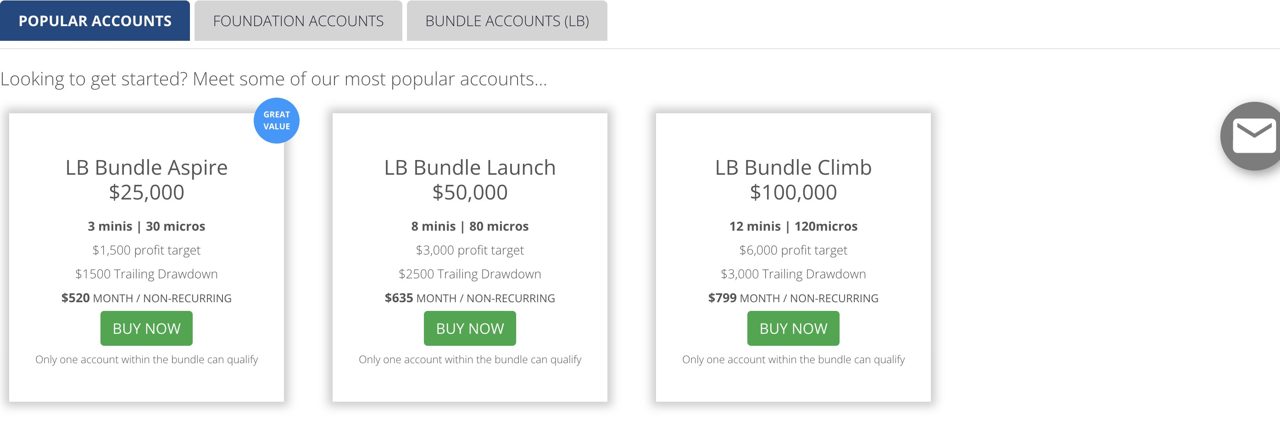
| Program | Published price / size | Important limitation |
|---|---|---|
| LB Bundle | $25K $520; $50K $635; $100K $799; $150K $850; $250K $950; $300K $1,250 | Homepage labels each “month / non-recurring”; only one account within a bundle can qualify. Phase-out notice applies. |
| Express | $119 for 14 calendar days; up to 12 contracts | $6,000 target, $3,000 trailing drawdown, ten active US trading days. Refund only on PA activation at the full $119 purchase price, with no profit rollover. |
| Ignite | $100K Practice Account; current purchase price not confirmed in the reviewed text | 20 calendar days, $6,000 target, $3,000 drawdown, up to 14 minis; documentation describes qualification into a $150K Cruise Investor PA with $5,000 drawdown. |
| LE Entry | Practice purchase prices not confirmed; PA $44/month or $250 one-time | LE’s own page specifies 50% of eligible simulated profits, not the general 100%/90% formula. |
| WK Weekly | $25K or $50K; Practice prices not confirmed; PA $88/month or $250 one-time | Legacy weekly instructions differ from the newer consolidated payout guide. |
| Elite | Current purchase prices and sizes not established by this review | Overview flags phase-out. Do not use a legacy payout schedule as proof of current availability. |
Express’s refund is conditional, not a free account upfront. Its calendar starts at purchase, so weekends and holidays can leave little room to complete ten active days. Ignite is a limited-time product; the ordinary homepage’s “no maximum trading period” statement does not apply to these time-limited accounts. The old help articles remain useful descriptions, but neither a surviving article nor a purchase link proves checkout availability.
How does Leeloo’s trailing drawdown work?
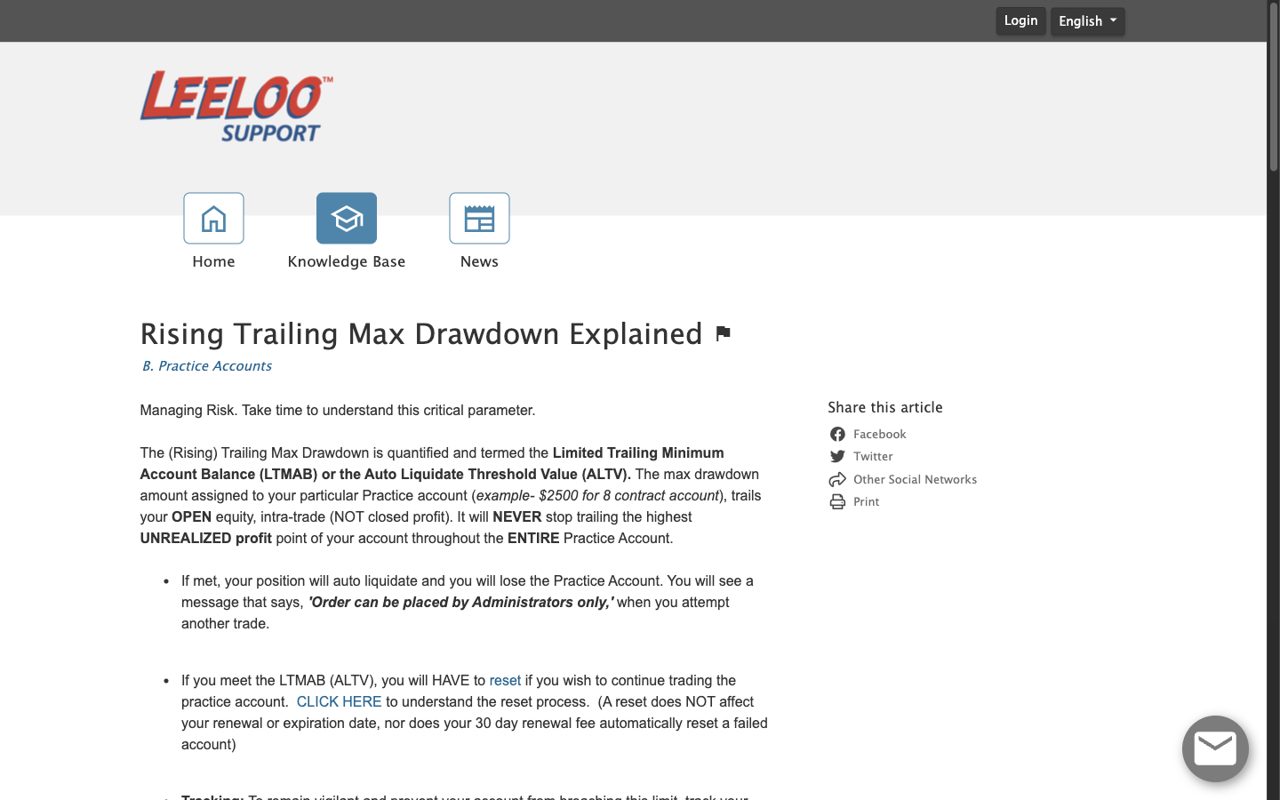
The drawdown guide defines the Auto Liquidate Threshold Value (ALTV), also called the Limited Trailing Minimum Account Balance. It follows your highest unrealized open equity intratrade. It moves up when equity makes a new high and does not move back down when a trade gives back profit. Touching it triggers liquidation and loss of the Practice Account. It never stops trailing during that Practice Account, even after the profit target is exceeded.
Illustrative $50K Practice Account example: with a $2,500 trailing allowance, the initial floor is $47,500. If open equity reaches $52,000, the floor rises to $49,500. Closing the position at $51,000 does not lower the floor: remaining room is $1,500, not $2,500. Touching $49,500 fails the account. This is arithmetic applying the published rule, not a trade we placed; monitor the actual ALTV and allow for fees.
After passing, locking differs: the Investor/Foundation article gives its own $50K example: when peak unrealized equity reaches $52,600, the floor locks at $50,100 (starting balance plus $100). Turbo instead says its floor locks after the first payout at $25,100, $50,100 or $100,100 by size. Do not transfer one program’s lock rule to another.
What happens after you pass?
- The legacy post-pass guide says stop trading once the target and active days are met. Confirm the balance in R|Trader Pro and wait for the qualification email; contact support if it has not arrived after 48 hours.
- Use the instructions to choose the PA, complete Rise Works verification and pay the applicable PA fee. Turbo’s own terms list no activation fee; that does not erase fees on other plans.
- Use your real name and address and a valid government-issued ID matching the account. Unresolved Rise rejection prevents progression and payouts.
- The guide says activation follows within 48 hours of completing the steps. This is a vendor processing statement, not a timing guarantee tested by FundingCodes.
- Cancel the old monthly Practice subscription as directed by the guide. Do not assume passing automatically cancels it.
Leeloo payout eligibility, percentages and schedule
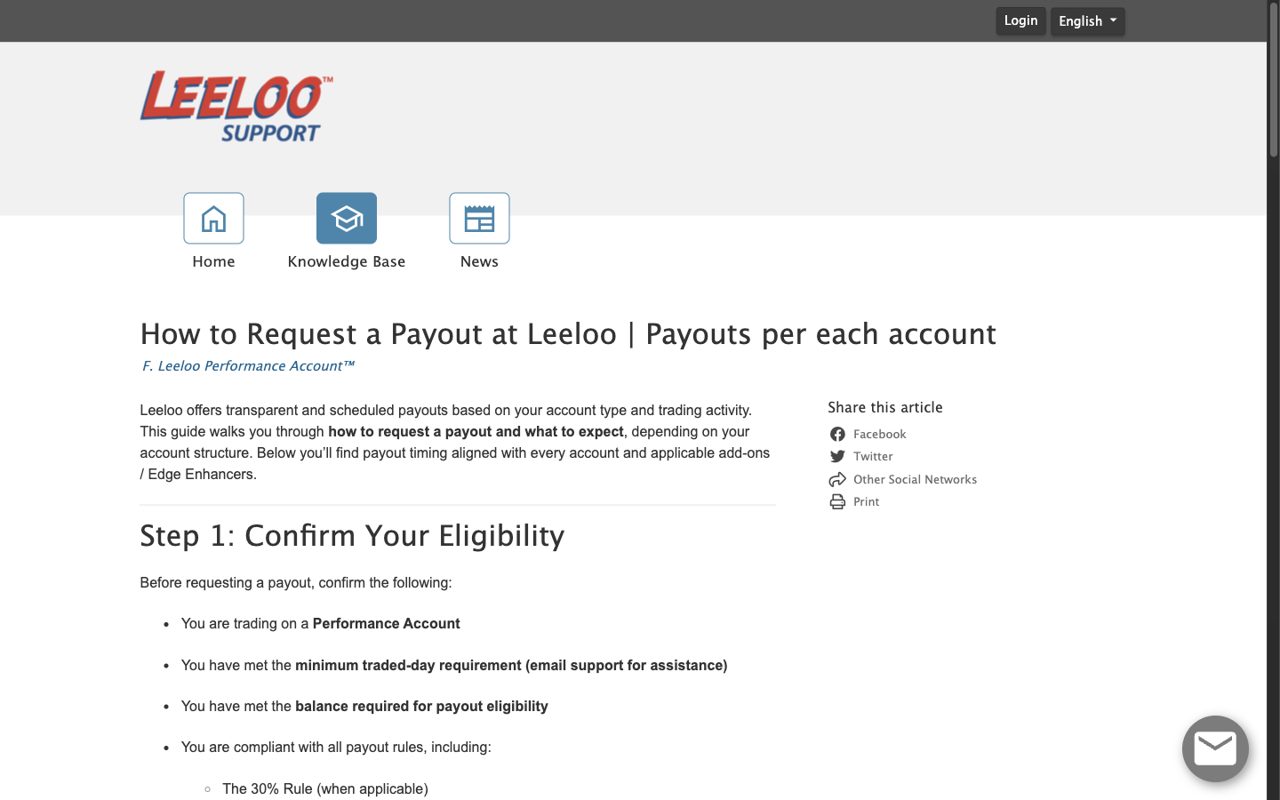
A request is not an approval. Leeloo’s overview explicitly describes discretionary performance-based contest payouts, rather than guaranteed earnings. Its general formula is 100% of the first $12,500 of eligible simulated profits and 90% thereafter, while saying this is not a conventional live-account “profit split.” LE is an important exception: its own page specifies 50%. Turbo applies the 90% rate after $12,500 in the trader’s lifetime payout history, not afresh on every small account.
Turbo payout limits
| Account | Minimum request | Maximum per request | Total payout cap | Floor after first payout |
|---|---|---|---|---|
| $25K Sprint | $250 | $400 | $2,000 | $25,100 |
| $50K Pace | $250 | $800 | $4,000 | $50,100 |
| $100K Power | $250 | $1,200 | $6,000 | $100,100 |
Turbo requires five winning traded days before the first request and five additional winning days for each later request. A winning day requires at least one closed trade and $200 net profit. The PA lasts 90 days and closes after the fifth payout regardless of remaining balance. The article also describes conditional bonuses of $500, $800 or $1,500 by size; these are merchant promises tied to milestones, not included in the payout caps above or independently confirmed receipts. Reaching 30 winning days can close the account; the article tells traders to submit eligible requests before that point.
The Turbo-specific article permits requests by email on any day after eligibility, says processing within 24 hours and arrival in Rise within 24–72 hours. The consolidated guide instead says review takes 1–3 business days. Treat those as different published processing descriptions, not an independently measured service level.
Foundation, LE and legacy WK are not Turbo
The consolidated guide lists LE/LB/LL first requests after 30 traded days, then every ten traded days within the last-Saturday-of-month window, 2 AM–5 PM “EST” as written by Leeloo. Eligible Edge Enhancers change traded-day requirements to ten or 15; they do not make every plan weekly. Foundation describes a $1,000 minimum for the first four payouts with account-specific balance thresholds and caps. LE’s page illustrates a $1,000 request yielding $500 and says 50% applies from month five onward too.
The legacy WK page describes ten traded days before the first request, four between later weekly requests, a $26,600 balance threshold at $25K or $52,600 at $50K, and request limits of $1,000 at $25K or $1,000–$1,500 at $50K. It prohibits copiers. Those terms must not be combined with Turbo’s five-winning-day schedule merely because the consolidated guide labels a row “Turbo (WK).”
Material conflicts to resolve before buying
- Request method: LE and WK pages still direct traders to the dashboard. The consolidated payout guide explicitly says dashboard requests are no longer accepted and all requests must be emailed to [email protected].
- Request day: Turbo’s specific article and the consolidated table say any day after five winning days. The same consolidated guide’s summary says Turbo WK requests require a designated Saturday window. WK itself mentions both 5 PM and 10 AM Saturday cutoffs.
- Later Foundation caps: its program article says the fifth payout onward has no minimum or maximum restriction, while the post-pass overview says minimums and maximums apply to every payout including the fifth and beyond. This review does not promise uncapped withdrawals.
- Consistency measurement: the 30% article says “below 30%,” later describes no day exceeding 30%, and mixes payout-period language with a clarification that the rule covers the PA’s lifetime. Ask support which denominator and strict boundary apply to your account.
For the consolidated guide’s process, request by email with PA number, amount and eligibility confirmation, use Rithmic as the final record, and do not trade during review. Confirm the correct schedule and time zone with support first. Meeting a dashboard percentage or seeing a request button does not establish eligibility.
Other rules that can affect a payout
The official consistency article discusses “flipping”: trades placed just to count a day rather than following the normal strategy. Leeloo says review considers trade count, contract usage, holding time, profit taking and stops, not a single dashboard formula. The overview also prohibits bots, automated execution, trading another person’s account and copying accounts you do not own. A target and a day count are therefore not the whole contract.
Copy permissions are plan-specific: Turbo permits up to five Turbo accounts, while WK and several add-on types prohibit copiers. The general ten-account limit also differs from Turbo’s five active PAs and its evaluation-specific wording. Confirm your mix rather than treating the highest headline limit as universal.
The homepage advertises news trading and swing trading, but its PA FAQ limits positions held through the close: up to three micros without permission; larger exposure needs approval and sufficient maintenance margin. It also instructs traders to flatten 15 minutes before close unless approved. “Swing trade” is not permission to ignore the detailed holding policy.
Which platforms does Leeloo support?
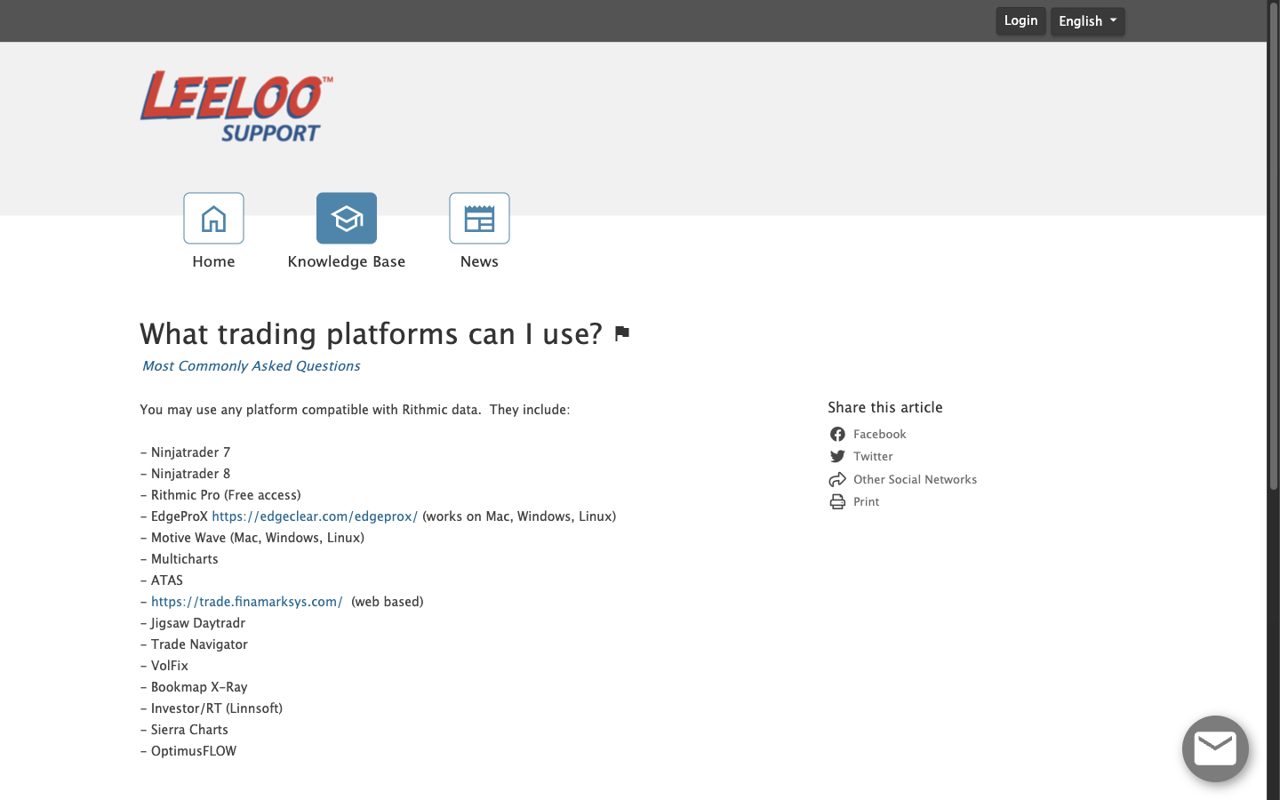
The platform guide lists Rithmic-compatible platforms, including NinjaTrader 7/8, R|Trader Pro, EdgeProX, MotiveWave, MultiCharts, ATAS, Finamark, Jigsaw Daytradr, Bookmap X-Ray, Investor/RT, Sierra Charts and OptimusFLOW. It labels R|Trader Pro access free. The homepage instructs traders to complete the Rithmic documents before connecting a platform. Individual licenses, compatibility and professional data costs still need checking; this review did not test these connections.
TradingView’s appearance on the homepage as a market widget does not establish TradingView order-entry support. It is not listed in the platform guide reviewed here.
Community reputation: what is and is not established
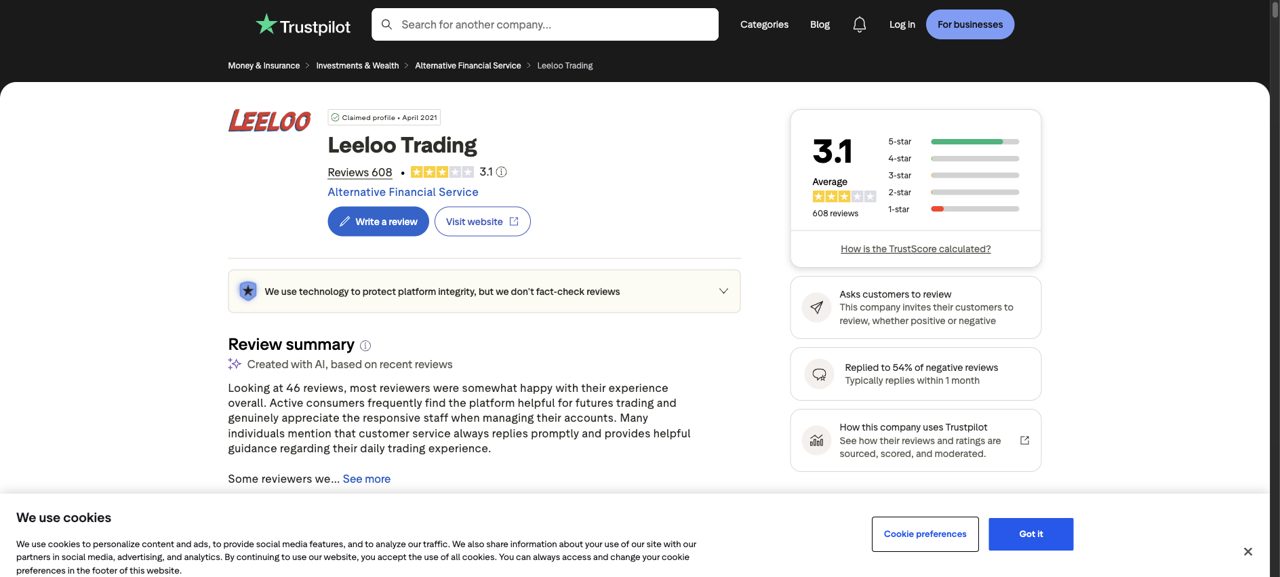
The Leeloo Trading Trustpilot profile showed 3.1/5 from 608 reviews when read September 26, 2026, with 82% five-star and 14% one-star reviews. Those are Trustpilot’s displayed figures, not a FundingCodes rating or an audit of payouts.
- Positive accounts: Mounia martin’s January 8, 2026 Trustpilot review says “they honored three payouts.” Randy Carroll’s October 29, 2025 (UTC) review praises timely customer-service responses. These are individual reviewers’ experiences; we did not independently verify their payments.
- Payout complaint and company response: in a June 7, 2026 Trustpilot review, Roger v alleges two $1,000 requests were reduced to $570 and $560 over contract-consistency criteria, with account closures. Leeloo’s same-day reply says reviews consider account-specific risk, consistency and trading behavior, not profit alone. The allegation and response do not establish which party’s interpretation of the account agreement is correct.
- Reddit: in “Personal experience on Leeloo,” r/proptrading, June 4, 2026, TomatilloPristine924 alleges a $1,000 request became a $580 discretionary distribution followed by closure over consistency findings. Similar wording appears in a Trustpilot complaint; we do not count the two posts as independent corroboration.
- Historical perspective only: “Pros & Cons of Leeloo Trading,” r/LeeLooTrading, June 4, 2022, by minisrikumar praises signup and deals but criticizes trailing drawdown and the 30-day payout wait. It is not evidence of current prices or rules.
The mixed accounts make payout review a material due-diligence issue, but they do not prove misconduct or establish a denial rate. Vendor testimonials and leaderboard results are not an audit either. FundingCodes has not independently verified these payouts, reductions or closures.
Documented advantages and drawbacks
Potential advantages
- Turbo publishes prices, targets, drawdown allowances and capped payout schedules together, with no PA activation fee.
- The published rules distinguish real market data from simulated account capital.
- Several Rithmic-compatible platform choices and no evaluation contract scaling in the general overview.
Reasons for caution
- Unrealized trailing drawdown can tighten your remaining cushion before you close a profitable trade.
- Program phase-outs make homepage availability claims uncertain.
- Payout timing, dashboard instructions, later payout caps and consistency wording conflict across official pages.
- Manual behavioral review and discretionary approval extend beyond a simple target-and-day-count checklist.
- Turbo’s duration and payout caps limit its value even if an account keeps producing simulated profit.
Alternatives and final verdict
Compare the structure you want, not only the starting balance. Our DayTraders review examines one-time fees and alternative drawdown models; the Bulenox review explains Qualification-to-Master mechanics; and the Elite Trader Funding review covers monthly evaluations and post-pass costs. Those are separate reviews, not claims that any alternative guarantees payouts.
Leeloo’s public documents offer enough detail to evaluate the mechanics, but not enough consistency to recommend buying on the homepage alone. Consider it only if its specific trailing rule and capped/discretionary payout path fit your needs and support confirms the unresolved terms. If you need unambiguous payout conditions before spending money, wait for written clarification rather than guessing which page controls.
Frequently asked questions
Is Leeloo Trading a live funded account?
Leeloo says traders receive simulated accounts with virtual capital at all stages. A Performance Account is not a brokerage account or a deposit of the advertised account size. Potential payouts are discretionary and subject to eligibility, verification and approval.
How much does Leeloo Trading cost?
Official pages read September 26, 2026 list Turbo at $88, $127 or $240 per month, with no activation fee, and Foundation accounts at $250–$850 per month plus a separate Performance Account fee. Foundation is marked for phase-out in the help center. These are published prices, not checkout-tested totals.
Does Leeloo drawdown follow unrealized profit?
Yes. Its Practice Account drawdown follows the highest open equity in real time and does not stop trailing during the evaluation. Touching the threshold fails the account. Performance Account locking rules differ by program.
When can I request a Leeloo payout?
Turbo documentation says after five winning traded days, each with a closed trade and at least $200 net profit, then every five additional winning days. Standard LE, LB and LL guidance says 30 traded days for the first request and a last-Saturday window. Official pages conflict about request timing and method; confirm your exact account with support.
Is there a Leeloo Trading coupon on FundingCodes?
No. Leeloo has issued FundingCodes no coupon code. Our Leeloo link is a referral link, not a buyer discount, and no checkout discount is claimed here.
Sources and review method
Official pages below were read September 26, 2026, including direct HTML reads because extracted homepage text omitted pricing. This is a desk review: no purchase, trading-account test, payout receipt, support confirmation or discount checkout test was performed. Missing prices are identified rather than estimated. A page’s modification date is not proof its terms apply to a new purchase.
- Homepage and Foundation/Bundle pricing — read September 26, 2026
- Program overview and phase-out notices — read September 26, 2026
- Turbo prices, rules and payouts — read September 26, 2026
- Unrealized trailing drawdown — read September 26, 2026
- Post-qualification process — read September 26, 2026
- Investor/Foundation parameters — read September 26, 2026
- Payout request guide — read September 26, 2026
- LE account payout terms — read September 26, 2026
- Weekly account terms — read September 26, 2026
- Consistency and flipping rules — read September 26, 2026
- Express account — read September 26, 2026
- Ignite account — read September 26, 2026
- Supported platforms — read September 26, 2026
- Terms of service — read September 26, 2026
Check Leeloo’s current account terms
Confirm availability, all fees and the payout rules for your exact plan before paying.